


Institutional Shareholder Services (ISS) has published its 2027 Benchmark Policy Update, introducing global and market-specific changes affecting Canadian and U.S. issuers across board composition, director accountability, risk oversight and equity compensation. The updated guidelines apply to shareholder meetings held on or after February 1, 2027.
While Glass Lewis’ North American benchmark guidelines remain unchanged for 2027, its transition to four research perspectives in September 2027 will reshape the voting recommendation landscape for the 2028 proxy season.
North American issuers should address the immediate ISS policy changes while preparing for an increasingly differentiated voting environment in 2028.
Global Policy Updates
The following global policy changes apply to both Canadian and U.S. issuers.
AI and Cybersecurity Oversight
ISS has explicitly incorporated extraordinary failures of artificial intelligence (AI) and cybersecurity oversight into its director accountability framework. Material failures in board oversight of these risks may result in adverse voting recommendations against directors.
Climate-Related Board Accountability
ISS is replacing its prescriptive approach to climate-related director accountability at significant greenhouse gas emitters with a case-by-case assessment, providing greater flexibility in evaluating company-specific climate risk management practices.
Policy Update Applicable to Canada and the U.S.
Shareholder Value Transfer Methodology
ISS is replacing its binomial option-pricing model with the Black-Scholes methodology for equity compensation assessments in Canada and the U.S., including option plans, option exchanges and stock-in-lieu-of-cash arrangements. The change aligns option valuations with methodologies already used in ISS’ burn rate, pay-for-performance and realizable pay analyses.
Canadian Benchmark Policy Updates
Board Gender Diversity
ISS has adjusted the application of its 30% gender diversity threshold for S&P/TSX Composite issuers. Seven-member boards may now satisfy the requirement with two female directors instead of three. Newly added Composite constituents will also benefit from a two-year transition period.
Director Independence and Family Relationships
Relatives of former CEOs will be assessed on a case-by-case basis where the former CEO is no longer affiliated with the company or has been deemed an independent director. The clarification provides greater flexibility in assessing director independence beyond the existing cooling-off framework.
Management Deferred Share Unit (DSU) Plans
Management DSU plans will now be evaluated under the Equity Plan Scorecard (EPSC), replacing the standalone assessment framework. The change integrates DSU costs and dilution into broader equity plan assessments while retaining overriding concerns relating to non-executive director participation limits, repricing and amendment authority.
Employee Share Purchase and Ownership Plans
ISS has clarified its assessment of employee share purchase and ownership plans featuring employer matching contributions above 25%, purchase prices below 80% of fair market value or combined effective discounts exceeding 20%.
Plans exceeding any of these thresholds will be subject to Shareholder Value Transfer (SVT) assessment for TSX-listed issuers and receive adverse voting recommendations for TSX Venture-listed issuers.
Board Authority to Amend Articles and Bylaws
ISS will explicitly oppose provisions granting boards authority to amend articles or bylaws without shareholder approval in jurisdictions where corporate statutes permit such authority, including British Columbia. The amendment formalizes ISS’ longstanding position on preserving shareholder oversight of changes to governing documents.
U.S. Benchmark Policy Updates
Charter and Bylaw Ratification Proposals
ISS has expanded its director accountability framework to capture the use of ratification proposals to exclude shareholder proposals at current or prior meetings. First-time use of such mechanisms may now result in adverse voting recommendations against directors.
Equity Plan Scorecard
ISS has eliminated the EPSC factor assessing the proportion of CEO equity awards granted as performance-based compensation, recognizing that predominantly or exclusively time-based equity awards do not inherently indicate pay misalignment.
Glass Lewis’ 2027 Guidelines and Four Research Perspectives
Glass Lewis’ new advisory model reflects increasingly differentiated investor stewardship priorities. Following public consultation, Glass Lewis refined its four research perspectives to accommodate varying approaches to financial performance, governance standards, shareholder rights and sustainability risks.
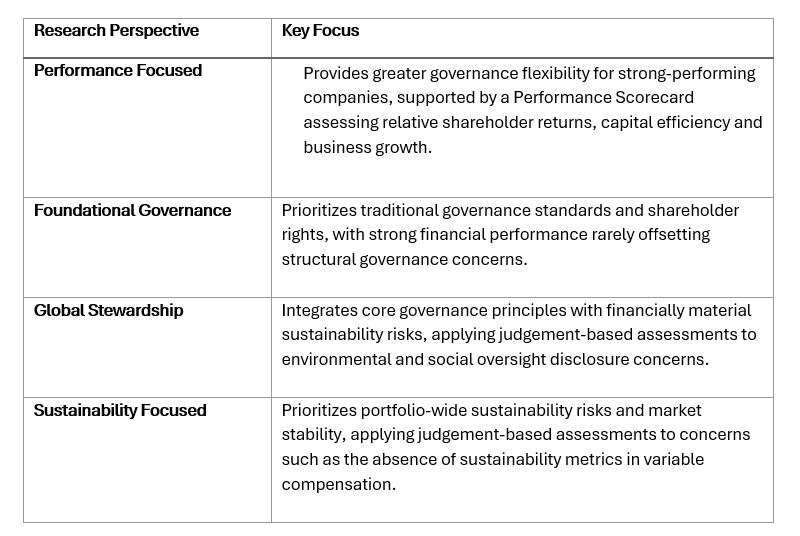
The new model could result in divergent voting recommendations on the same proposal, making shareholder-specific voting intelligence increasingly critical to effective engagement and proxy solicitation.
Preparing for the 2027 and 2028 Proxy Seasons
Canadian issuers should use the upcoming proxy season to assess their exposure to revised ISS policies and prepare for increasingly differentiated voting recommendations under Glass Lewis’ new advisory model.
- Strengthen board risk oversight. Review AI, cybersecurity and climate-related oversight frameworks, committee mandates and disclosures.
- Reassess board composition and governing documents. Evaluate director independence, gender diversity and provisions governing board authority against revised ISS policies.
- Model equity compensation proposals. Assess proposed equity, DSU and employee share purchase or ownership plans against updated ISS criteria and valuation methodologies.
- Map shareholder voting and stewardship preferences. Identify the policies influencing key shareholders’ voting decisions and assess potential exposure under Glass Lewis’ four research perspectives.
- Engage shareholders early. Identify governance vulnerabilities and address potentially contentious proposals ahead of annual meetings.
Kingsdale Advisors helps issuers navigate evolving proxy advisor policies, anticipate voting outcomes and develop targeted shareholder engagement strategies to secure shareholder support.
Latest Insights
Coming to Vancouver | Governance on the Move: Shareholder Engagement in a New Era
On October 20, 2026, Kingsdale Advisors is hosting an in-person event in Vancouver, where senior leaders from the firm will share latest industry insights. Register your interest to attend.
Modernizing Take-Over Bid Rules Without Losing Market Flexibility
The Canadian Securities Administrators closed a 90-day consultation period earlier this month on proposed amendments to Canada’s issuer bid, take-over bid and beneficial ownership reporting regimes. Investors need decision-useful information, while market participants need the flexibility to engage, adapt and execute effectively.
Upcoming Event | Governance on the Move: Shareholder Engagement in a New Era
On September 23, 2026, Kingsdale Advisors is hosting an in-person event in Toronto, where senior leaders from the Ontario Securities Commission, Glass Lewis, and Canadian Coalition for Good Governance will share latest industry insights. Register your interest to attend.

When The Stakes Are Highest, Business Leaders Choose Kingsdale
Subscribe to Our Newsletter

* Source: Bloomberg Global Shareholder Activism League Tables FY2025 and LSEG Global Shareholder Activism Review FY2025.
#2025 and 2026 indicate proxy seasons: July 2024 to June 2026.